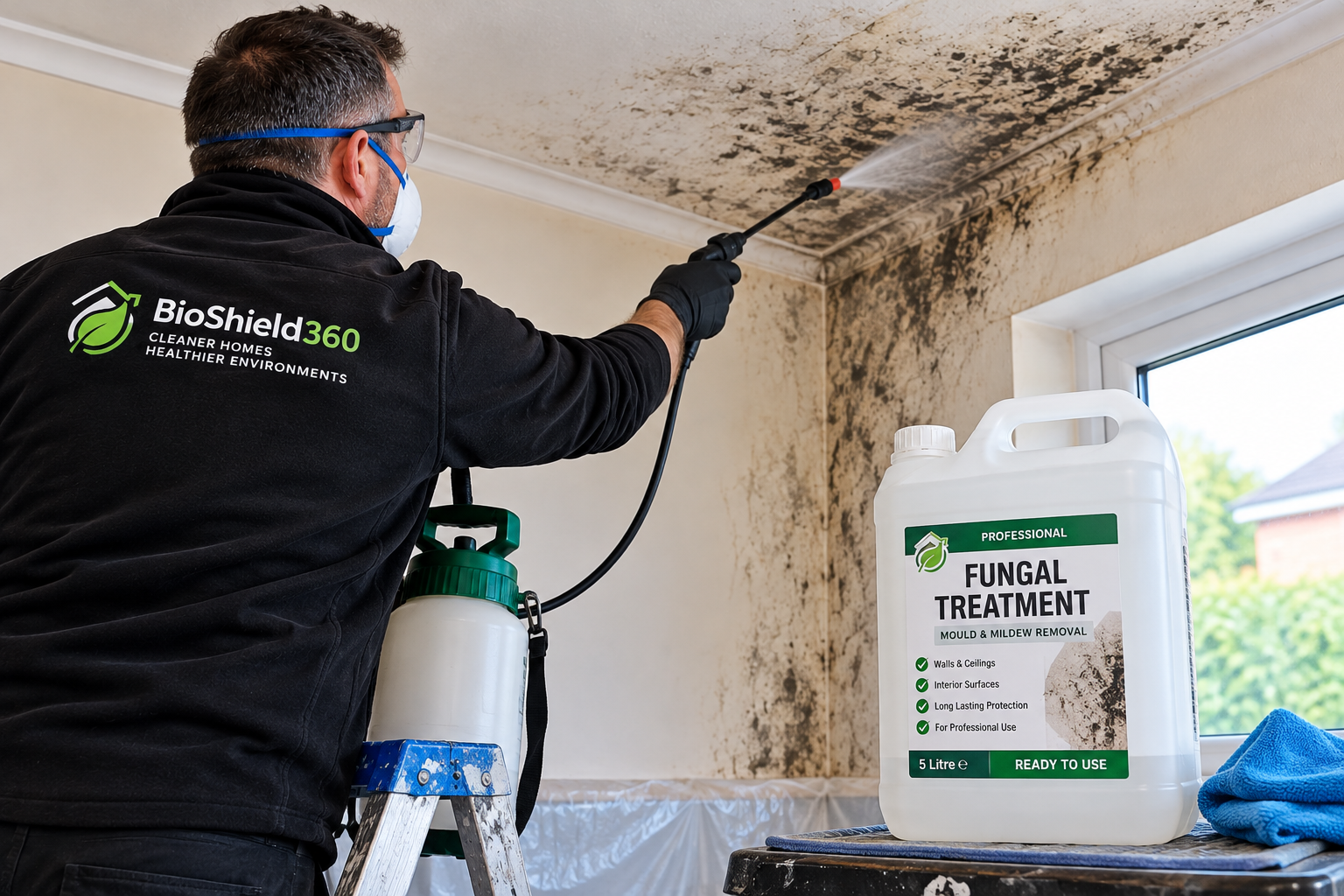
Professional Fungal Treatment for Mould on Walls and Ceilings
Mould Removal and Fungal Treatment in Wakefield & West Yorkshire | BioShield360
Fungal mould growth on walls and ceilings is a common problem in residential properties, rental homes and commercial buildings. Black, grey or green patches can develop when moisture, condensation and poor ventilation create favourable conditions for mould to grow.
At BioShield360, we provide professional mould cleaning and targeted fungal treatment to help remove visible mould contamination from suitable wall and ceiling surfaces.
Our service combines surface cleaning, appropriate mould treatment and moisture readings to help assess the affected areas and identify conditions that may contribute to recurring mould growth.
What Is Fungal Mould Treatment?
Fungal mould treatment involves cleaning affected surfaces and applying an appropriate treatment to help control remaining mould contamination.
Mould can grow on painted walls, plaster, ceilings, window reveals and other building surfaces where moisture is present. Although cleaning may remove visible growth, the underlying moisture problem must also be addressed to reduce the likelihood of recurrence.
Professional treatment is particularly useful where mould has spread beyond a few isolated patches or where customers need help assessing the condition of several affected surfaces.
Common Signs of Mould on Walls and Ceilings
Mould growth can appear in several forms, including:
- Black or dark patches on walls and ceilings.
- Grey or green fungal growth around windows.
- Mould developing in ceiling corners.
- Staining above windows or behind furniture.
- Musty or damp odours.
- Recurring mould after household cleaning.
- Discolouration on cold external walls.
Mould growth may be associated with condensation, inadequate ventilation, leaks or other building defects. Identifying the likely cause is important before deciding on the most appropriate treatment.
Our Professional Wall and Ceiling Fungal Treatment Process
1. Inspection of affected surfaces
We inspect the visible mould growth, the condition of the walls and ceilings, and any signs of dampness or deterioration.
The inspection helps determine whether the surfaces are suitable for cleaning and treatment or whether damaged plaster, persistent water ingress or specialist remediation may need further attention.
2. Wall and ceiling moisture readings
We use a suitable moisture meter to assess selected wall surfaces where appropriate.
Readings can help identify variations in moisture conditions and indicate where additional investigation may be necessary. Results must be interpreted according to the material and type of meter used.
Where appropriate, room temperature and relative humidity may also be checked to help assess condensation risk.
3. Professional mould cleaning
Affected surfaces are cleaned using a method appropriate to the material and the extent of the contamination.
The objective is to remove visible mould growth and surface residue while minimising unnecessary disturbance and the spread of contaminated material.
Ceilings and painted walls require particular care because excessive moisture or aggressive cleaning can damage the finish.
4. Targeted fungal treatment
After suitable cleaning, an appropriate mould treatment may be applied in accordance with the product instructions and the condition of the surface.
The treatment is selected for the intended application and must be used with suitable precautions, including ventilation and any required personal protective equipment.
A surface treatment is not a substitute for repairing leaks, resolving persistent condensation or replacing severely damaged building materials.
5. Moisture and humidity advice
Following the treatment, we provide practical advice where appropriate to help reduce the conditions that encourage mould growth.
Recommendations may include improving ventilation, managing indoor humidity, reducing condensation and investigating possible water ingress.
Where moisture readings indicate a potential underlying problem, further assessment or remedial work may be required.
Why Does Mould Return After Treatment?
Mould can return when the conditions that supported its growth remain unchanged.
Common causes include:
Condensation: Moist indoor air contacts cold walls or ceilings, allowing water to form on the surface.
Poor ventilation: Moisture from cooking, bathing and drying clothes accumulates indoors.
Cold surfaces: External walls and ceiling corners can become cold enough to encourage condensation.
Leaks and water ingress: Plumbing defects, damaged roofs and other building problems may keep materials damp.
Damaged building materials: Porous or deteriorated plaster may require repair or replacement if cleaning alone is insufficient.
Effective mould management therefore involves both appropriate surface treatment and attention to the underlying moisture conditions.
Is Fungal Treatment Suitable for All Walls and Ceilings?
Not every affected surface can be treated in the same way.
Painted plaster, bare plaster, wallpaper, textured coatings and damaged ceiling materials can respond differently to cleaning and treatment.
Small, accessible areas may be suitable for routine professional cleaning. Extensive growth, heavily contaminated porous materials, significant water damage or mould affecting concealed spaces may require specialist assessment.
If the mould is widespread or the cause is uncertain, an inspection should establish the appropriate scope of work before treatment begins.
BioShield360 Mould Treatment Prices
Our standard mould removal service starts at £125 per room.
Service| Price
One standard room| £125
Two standard rooms| £250
The standard service includes moisture readings, cleaning of affected wall surfaces and appropriate mould treatment.
Ceiling treatment, extensive mould growth, damaged plaster, specialist remediation and additional humidity-control equipment may require a separate quotation depending on the size and condition of the affected areas.
We confirm the scope and price before additional work is undertaken.
Professional Mould Treatment in Wakefield and West Yorkshire
BioShield360 provides mould cleaning and fungal treatment services for homeowners, landlords, letting agents and property managers.
We cover Wakefield and surrounding areas of West Yorkshire, helping customers address visible mould and assess moisture conditions in their properties.
Whether mould is affecting one wall, a bedroom ceiling or several rooms, we can discuss the problem and recommend an appropriate service.
Need professional mould treatment?
Contact BioShield360 to discuss your property and arrange a quotation.
Website: https://www.bioshield360.co.uk
Email: iaq@bioshield360.co.uk
Telephone: 07450 476017
BioShield360 — Professional mould cleaning, fungal treatment and moisture assessment.