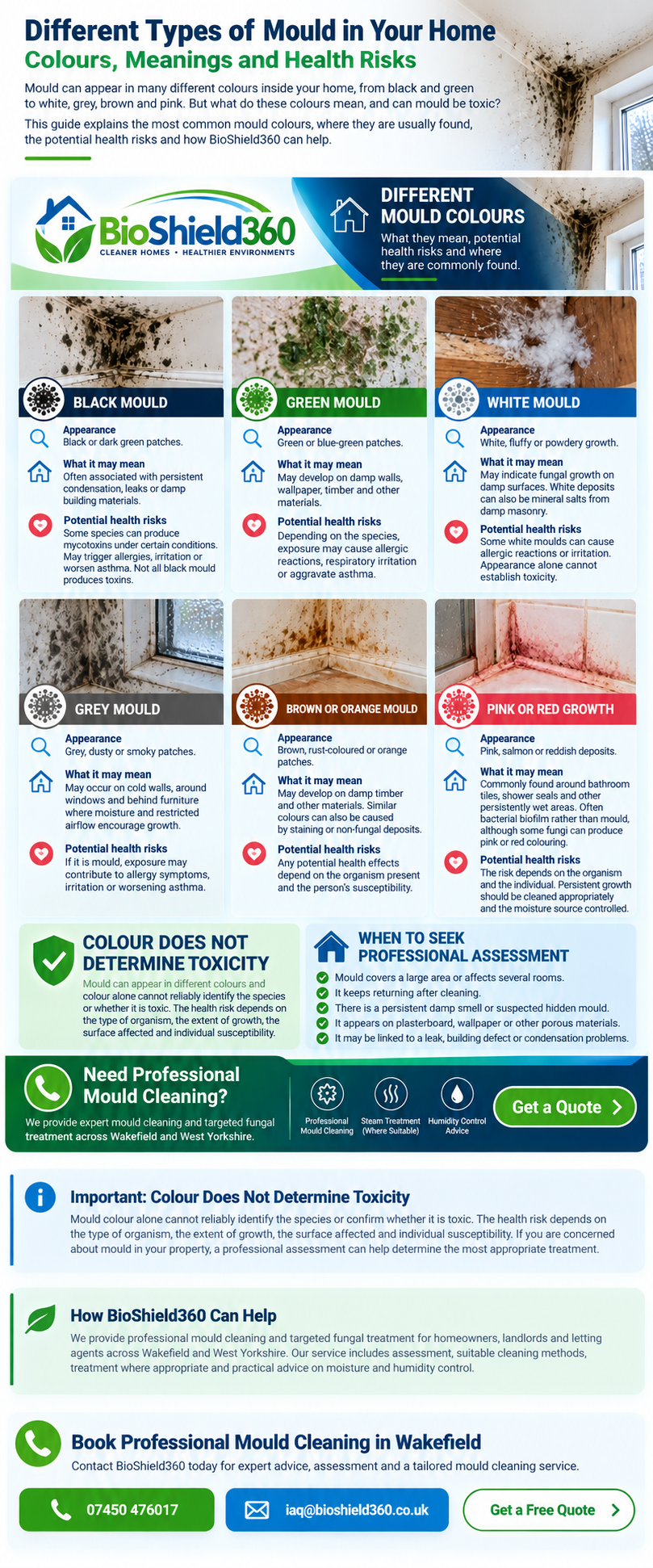
Different Types of Mould in Your Home: Colours, Meanings and Health Risks
Mould can appear in many different colours inside your home, from black and green to white, grey, brown and pink. But what do these colours mean, and can mould be toxic?
At BioShield360, we provide professional mould cleaning and targeted fungal treatment across Wakefield and West Yorkshire. Understanding the different types of visible mould can help homeowners, landlords and letting agents recognise potential problems and decide when professional assessment may be appropriate.
Important: Mould colour alone cannot identify the species or determine whether it is toxic. The source of moisture, extent of growth and type of organism are more important when assessing the problem.
1. Black Mould
Appearance: Black, dark brown or dark green patches.
Black mould commonly appears on damp walls, ceilings, window frames and behind furniture. Persistent condensation, leaking pipes and other sources of moisture can create conditions that encourage its growth.
Some moulds described as black mould, including Stachybotrys chartarum, can produce mycotoxins under certain conditions. However, not all black mould is this species, and not all black mould produces toxins.
Potential health risks: Indoor mould exposure may cause allergic reactions, irritation and worsening asthma symptoms in susceptible people.
Professional treatment: Suitable surface cleaning, targeted fungal treatment where appropriate, and investigation of the moisture source.
2. Green Mould
Appearance: Green, dark green or blue-green patches.
Green mould may develop on damp plaster, wallpaper, timber, stored belongings and other materials. Some species belonging to the Penicillium and Aspergillus groups can appear green.
Not every green mould is toxic. Certain species can produce harmful substances under particular conditions, but colour alone cannot establish this.
Potential health risks: Exposure may contribute to allergic symptoms, respiratory irritation or worsening asthma.
Professional treatment: Assessment of the affected material, appropriate cleaning and a suitable fungal treatment where indicated.
3. White Mould
Appearance: White, fluffy, powdery or cotton-like growth.
White fungal growth can develop on damp wood, walls, furniture and other porous materials. However, white deposits on brickwork or plaster may also be mineral salts left behind by moisture rather than mould.
It is important to distinguish between fungal growth and other deposits before deciding on treatment.
Potential health risks: Some moulds can cause allergic reactions and irritation. White colour does not mean the growth is harmless.
Professional treatment: Assessment to determine whether the deposit is mould or another substance, followed by an appropriate cleaning or remediation method.
4. Grey Mould
Appearance: Grey, smoky or dusty-looking patches.
Grey mould-like growth may develop around windows, in cold room corners, behind wardrobes and on walls with persistent condensation.
Restricted airflow and cold surfaces can contribute to moisture accumulation, particularly where furniture is positioned tightly against external walls.
Potential health risks: If the growth is mould, exposure may contribute to allergy symptoms, irritation or worsening asthma.
Professional treatment: Suitable mould cleaning combined with practical advice on ventilation, condensation and humidity control.
5. Brown or Orange Mould
Appearance: Brown, rust-coloured, tan or orange patches.
Brown or orange fungal growth may occur on damp timber, window frames and other affected materials. However, similar colours can also result from water staining, corrosion, mineral deposits or other non-fungal substances.
The appearance should therefore be assessed before a treatment is selected.
Potential health risks: Any health risk depends on the organism present, the extent of growth and individual susceptibility. Colour alone cannot establish toxicity.
Professional treatment: Identification of the likely surface problem, suitable cleaning and investigation of persistent moisture where necessary.
6. Pink or Red Growth
Appearance: Pink, salmon-coloured or reddish deposits.
Pink or red growth is often seen around shower seals, bathroom tiles, grout and other persistently wet surfaces.
Unlike many people assume, pink bathroom growth is frequently bacterial biofilm, such as Serratia, rather than mould. Some fungi can also produce pink or red colouring.
Potential health risks: The risk depends on the organism and the individual. Some bacteria can cause infections in susceptible people, so persistent growth should be cleaned appropriately.
Professional treatment: Appropriate cleaning for the affected material, with moisture control to help reduce recurrence. Treatment should be selected according to the type of contamination rather than its colour alone.
Is Any Colour of Mould More Toxic Than Another?
Not necessarily. Black mould is often associated with toxicity, but black colour does not prove that a mould produces mycotoxins. Green, white and other moulds can also include species capable of producing harmful substances under certain conditions.
For typical indoor mould problems, the practical priority is to address visible growth and the underlying moisture problem. Laboratory identification may be useful in specific circumstances, but the colour of a patch is not a reliable substitute for testing.
People with asthma, allergies or weakened immune systems may be more vulnerable to some effects of mould exposure. Children and older adults may also require particular consideration.
If mould exposure appears to worsen breathing problems, seek appropriate medical advice.
Where Does Mould Commonly Grow?
Mould can develop in several areas of a property, including:
- Walls and ceilings affected by condensation.
- Window frames and window reveals.
- Bathrooms, shower seals and kitchen areas.
- Behind wardrobes, beds and other furniture.
- Damp plasterboard, wallpaper and timber.
- Areas affected by roof leaks, plumbing leaks or other building defects.
The location of the growth can provide useful clues about the moisture source, but it does not confirm the mould species.
How Does BioShield360 Treat Mould?
Our professional mould cleaning service is tailored to the affected surface and the extent of contamination.
Depending on the assessment, treatment may include:
1. Surface assessment: Examining visible growth and considering possible moisture sources.
2. Mould cleaning: Removing visible mould using methods suitable for the material.
3. Targeted fungal treatment: Applying a suitable treatment to compatible surfaces where appropriate.
4. Steam treatment: Using high-temperature steam only where the surface can tolerate the heat and moisture.
5. Humidity-control advice: Explaining ventilation, condensation management and when dehumidifier hire may help.
Extensive mould growth, hidden contamination or heavily affected porous materials may require specialist remediation rather than surface cleaning alone.
How Can You Help Prevent Mould Returning?
Cleaning alone may not prevent mould from returning if the underlying conditions remain.
Practical measures include:
- Use extractor fans when showering or cooking.
- Ventilate rooms appropriately.
- Reduce persistent window condensation where practical.
- Avoid positioning large furniture tightly against cold external walls.
- Maintain suitable indoor humidity levels.
- Investigate leaks and persistent damp patches promptly.
- Consider dehumidification where appropriate.
Where building defects or water ingress are responsible, these problems need to be addressed as part of the overall solution.
Professional Mould Cleaning in Wakefield and West Yorkshire
If you have noticed black, green, white, grey, brown or pink growth in your property, BioShield360 can help assess the affected areas and recommend an appropriate cleaning and fungal treatment approach.
We support homeowners, landlords, letting agents and property managers across Wakefield and West Yorkshire.
Contact BioShield360 Ltd
Website: https://www.bioshield360.co.uk
Email: iaq@bioshield360.co.uk
Telephone: 07450 476017
BioShield360 — Cleaner Homes. Healthier Environments.